The Timeless Case for Natural Stone Slabs
Choosing a countertop material is one of the most defining decisions in any renovation. The surface you select sets the tone for the entire room.
Natural stone slabs carry a depth and visual richness that no manufactured product has fully replicated. Each piece is shaped over millions of years, making every slab genuinely one of a kind.
Engineered stone delivers real advantages: consistent patterning, lower porosity, and predictable color ranges. For high-traffic households, those qualities hold genuine appeal.
But when the goal is a surface that commands attention, ages gracefully, and holds long-term resale value, granite remains the stronger choice. This post breaks down the key differences, the best applications for each material, and how to find the right slab for your project.
Granite and engineered stone are both popular countertop materials, but natural stone offers unmatched character, heat resistance, and unique veining that manufactured surfaces cannot fully replicate. While quartz countertops provide consistency and easy upkeep, granite brings a one-of-a-kind presence that elevates kitchens and bathrooms alike.
Why Natural Stone Countertops Are Worth the Investment Over Engineered Stone
Granite forms deep within the earth under extreme pressure and heat. That geological process produces a material of remarkable hardness and visual complexity.
No two slabs share the same veining, mineral deposits, or color distribution. This individuality is precisely what separates natural surfaces from engineered alternatives.
Beyond aesthetics, granite scores high on durability. It resists scratches, tolerates heat without protective pads, and lasts decades when properly sealed.
Homeowners upgrading their countertops consistently report that natural stone adds measurable value at resale. Buyers respond to the authenticity that only geological time can produce.
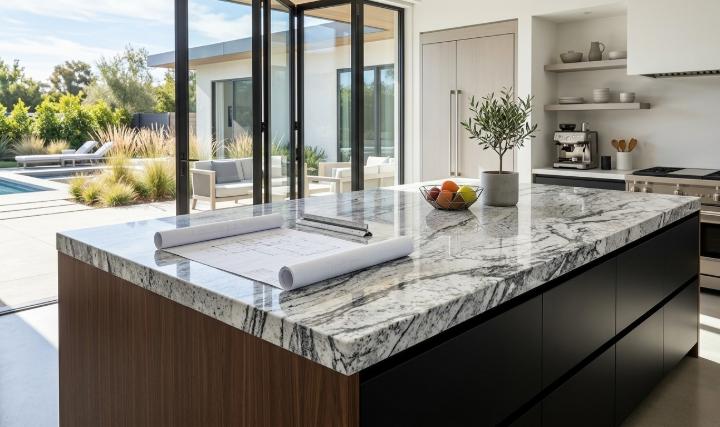
Key Advantages at a Glance
- Unique character: No two slabs are identical, ensuring an exclusive look
- Heat resistance: Granite withstands hot cookware without surface damage
- Longevity: Properly maintained slabs last the lifetime of the home
- Resale value: Natural stone is a recognized premium feature among buyers
- Environmental credentials: Stone is a natural material with no synthetic binders; learn more about responsible natural stone labeling
Engineered Stone: Where It Has the Edge
Engineered quartz scores well on stain resistance and requires no sealing. It suits homeowners who prioritize low-maintenance surfaces.
Color consistency makes quartz appealing for large installations where uniform appearance is critical. Designers often specify it for modern, monochromatic schemes.
However, quartz can discolor under prolonged UV exposure and lacks the thermal tolerance of granite. For outdoor kitchens or sun-drenched spaces, natural stone performs more reliably.
Granite vs. Engineered Stone: Side-by-Side Comparison
Feature | Granite (Natural Stone) | Engineered Quartz |
Appearance | Unique veining, no two alike | Consistent, uniform patterning |
Heat Resistance | Excellent | Moderate (can discolor) |
Scratch Resistance | Very high | High |
UV Resistance | Excellent | Poor to moderate |
Maintenance | Periodic sealing required | Minimal, no sealing needed |
Eco Profile | Natural material, no binders | Contains polymer resins |
Resale Appeal | Premium, high buyer recognition | Good, widely accepted |
Cost Range | Moderate to high | Moderate to high |
Pros and Cons: Natural Stone Slabs
Pros
- Irreplaceable visual character shaped by nature
- Exceptional heat and scratch resistance
- Proven long-term durability
- Adds recognized premium value at resale
- No synthetic materials or chemical binders
Cons
- Requires periodic sealing to prevent staining
- Heavier than engineered alternatives, requiring reinforced cabinetry
- Veining variation can make matching multiple slabs challenging
- Higher fabrication and installation costs on complex layouts
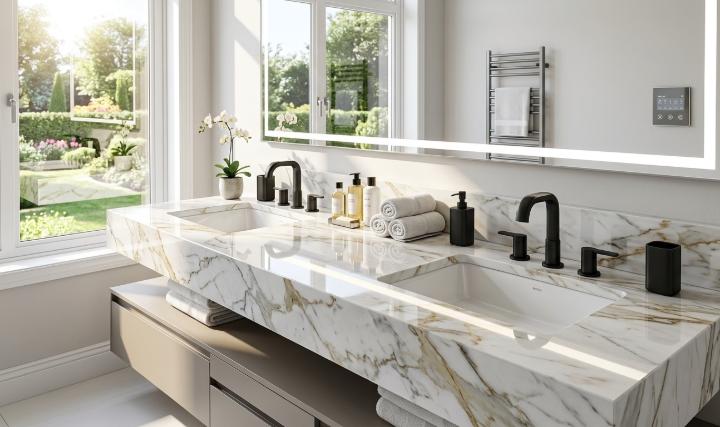
Practical Design Ideas: Where Natural Stone Makes the Greatest Impact
The material performs beautifully across multiple applications. Knowing where to use it strategically helps homeowners get the most from their investment.
For guidance on current material trends across residential and commercial projects, the International Surface Event is an excellent resource for architects and design professionals.
Kitchen Island Applications
A kitchen island topped with a full granite slab instantly becomes the focal point of the room. The natural patterning draws the eye and anchors the entire kitchen design.
Waterfall edges on an island countertop allow the full depth of the veining to wrap around the sides. This approach showcases the slab as a sculptural element, not simply a work surface.
Bookmatching two slabs so their mirrored veining meets at the center creates a dramatic, symmetrical effect. This technique works especially well on large island surfaces where the full pattern can breathe.
Bathroom Vanity Transformations
A bathroom vanity topped with granite shifts the room from functional to refined. The rich mineral tones pair naturally with warm wood cabinetry or brushed metal fixtures.
Thinner slab profiles work well in bathroom applications where the countertop does not bear the same weight load as a kitchen surface. This also reduces material cost without sacrificing appearance.
For a cohesive look, carry the same slab material from the vanity top to a feature wall panel or tub surround. Continuity of material creates a spa-like sense of calm.
Statement Walls and Feature Panels
Natural stone slabs are not limited to horizontal surfaces. Large-format slabs installed vertically behind fireplaces or as accent walls add drama to living spaces.
The low-porosity finish of polished granite makes it practical for wall applications, requiring less maintenance than softer stone varieties. For deeper guidance on stone countertop options, This Old House offers useful background on installation and care.
Mini Step-by-Step Guide: Selecting the Right Granite Slab
Step 1: Define Your Color Palette Start with the fixed elements in the room, such as flooring, cabinetry, and wall color. Identify the dominant tones and choose a slab that complements rather than competes.
Step 2: Visit a Showroom and View Full Slabs Samples provide limited information. Viewing a full slab in person reveals the true scale of veining and movement that a small sample cannot convey.
Step 3: Consider Finish Options Polished finishes amplify color depth and veining. Honed surfaces offer a softer, matte appearance. Leathered finishes add texture and hide fingerprints effectively.
Step 4: Assess Structural Requirements Confirm that existing cabinetry can support the weight of natural stone. Heavier slabs may require additional cabinet reinforcement before installation.
Step 5: Request a Fabrication Consultation Work with a professional fabricator to plan edge profiles, seam placement, and cutouts before the slab is ordered. Careful planning minimizes material waste and ensures a cleaner finished result.
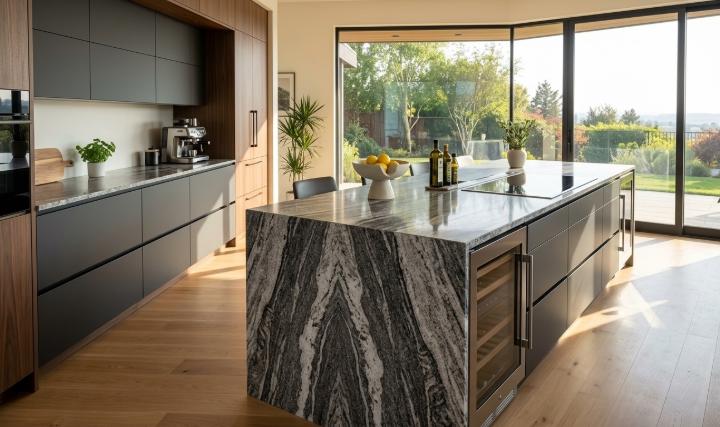
Finding the Right Slab: How to Source Natural Stone with Confidence
Sourcing the right material is as important as choosing it. Not all suppliers offer the same quality, range, or professional support.
Nova Tile and Stone maintains an extensive slab collection that spans granite, quartzite, marble, and beyond. The selection is curated to serve both residential homeowners and trade professionals.
Their shop local program connects customers with regionally available inventory, reducing lead times and keeping projects on schedule.
For design professionals and contractors, a trade account unlocks dedicated pricing and priority service. It is a practical advantage for anyone managing multiple renovation projects simultaneously.
Physical locations make it easy to view slabs at full scale before committing. The Reno showroom, Minden location, Fernley area, and Sacramento showroom all carry in-stock inventory and offer expert consultation.
Seeing a slab in person, under natural light and alongside your chosen fixtures, removes the guesswork that online ordering introduces. That hands-on confidence is worth the trip.
Conclusion
Engineered stone is a capable, practical material. For homeowners who prioritize low maintenance above all else, it delivers on its promises.
But natural stone slabs occupy a different category altogether. The character, warmth, and sheer visual depth they bring to a kitchen island, bathroom vanity, or any countertop surface cannot be manufactured into existence.
Granite is not a trend. It is a material that has anchored beautiful interiors for generations and will continue to do so. When you invest in natural stone, you are choosing a surface that becomes more familiar and more valued with time.
Ready to explore what is available? Visit the full collection online or stop into a showroom to see the slabs that could transform your next project.
Frequently Asked Questions
Is granite more durable than engineered quartz for kitchen countertops?
Granite is harder and more heat-resistant than engineered quartz. It handles hot cookware directly without surface damage, whereas quartz can discolor under sustained heat.
Does granite require a lot of maintenance?
Granite requires periodic sealing, typically once every one to two years depending on usage. Outside of sealing, it is cleaned with mild soap and water like any other surface.
Can natural stone slabs be used for bathroom vanity tops?
Yes. Granite and other natural stones are well suited to bathroom vanity applications. They resist moisture well when properly sealed and add a refined, lasting look to the space.
How do I choose between granite and quartzite?
Granite is generally harder and more stain-resistant than quartzite. Quartzite offers a more marble-like aesthetic for those who prefer softer veining and a more luminous appearance.
Where can I view full granite slabs before purchasing?
Visiting a showroom is the best approach. Viewing a full slab in person reveals veining scale and color depth that small samples do not capture accurately.