A bookmatched slab is a pair of natural stone slabs cut sequentially from the same quarry block, polished on opposite faces, and installed side by side so their veining mirrors each other symmetrically, like the pages of an open book. The technique transforms the stone's natural movement into a deliberate, symmetrical pattern that no two installations replicate exactly. Bookmatched slabs are most commonly used in kitchen countertops, large islands, full-height backsplashes, shower walls, bathroom vanities, and fireplace surrounds where the scale of the surface gives the mirror effect room to register. Stones with strong, directional veining, including marble, quartzite, granite, travertine, and onyx, are the best candidates for bookmatching. The result is a surface that functions as both a working architectural element and a visual focal point of the space.
How Bookmatching Works
The process begins at the quarrying stage. Large blocks of natural stone are transported from the quarry to a processing plant, where a gang saw, a multi-blade cutting tool that operates similarly to a bread slicer, cuts the block into individual slabs at a preset thickness. Under standard processing, slabs are polished on one face and bundled together before shipping to distributors and retailers.
Bookmatched slabs are handled differently. Instead of polishing the same face on each slab, the plant alternates the polishing direction, finishing one face of the first slab and the opposite face of the second. This means that when those two slabs are placed next to each other, their interior surfaces face outward, producing a mirror image of the stone's veining, movement, and color transitions.
Because bookmatched pairs come from the same block and the same sequential position within that block, the mineral composition, color, and movement on each slab are nearly identical. The closer the slabs sit in sequence within the block, the more precise the mirror becomes. This is why bookmatched slabs are typically numbered and kept together from the time they are cut, rather than being distributed separately into general inventory.
In some cases, a single thick slab can be split into two thinner slabs and polished on the facing surfaces to achieve a bookmatch. This approach allows buyers to choose the specific slab they want and commission a split, though it requires finding suitable thick-cut inventory.
Which Stones Work Best for Bookmatching
Bookmatching works best with stones that have strong, directional movement. Subtle, uniform stones do not produce much visual impact when mirrored because there is little pattern to reflect. Stones with bold veining, high color contrast, or flowing organic movement are the ideal candidates.
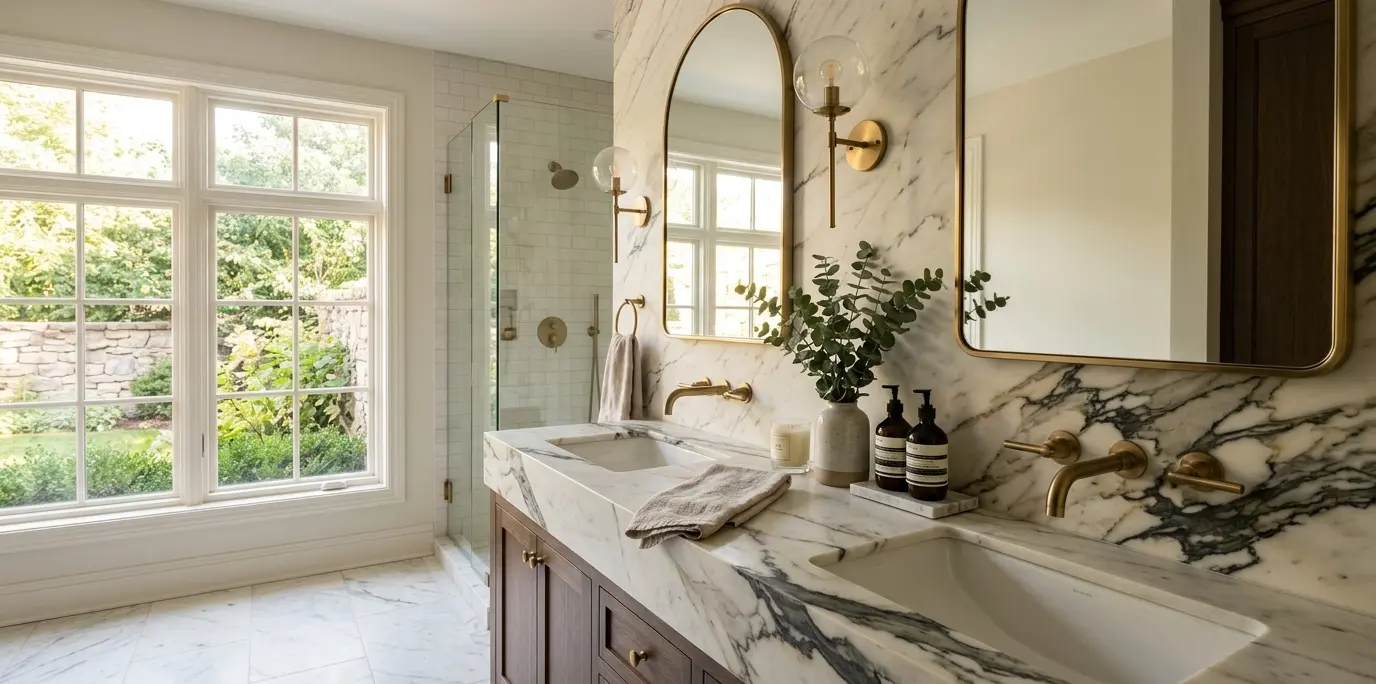
Marble is the most commonly referenced material for bookmatching. Its soft, flowing veins and color transitions produce dramatic butterfly-wing patterns when mirrored. Calacatta and Carrara varieties are among the most requested for this application, but virtually any marble with prominent movement is well-suited to the technique.
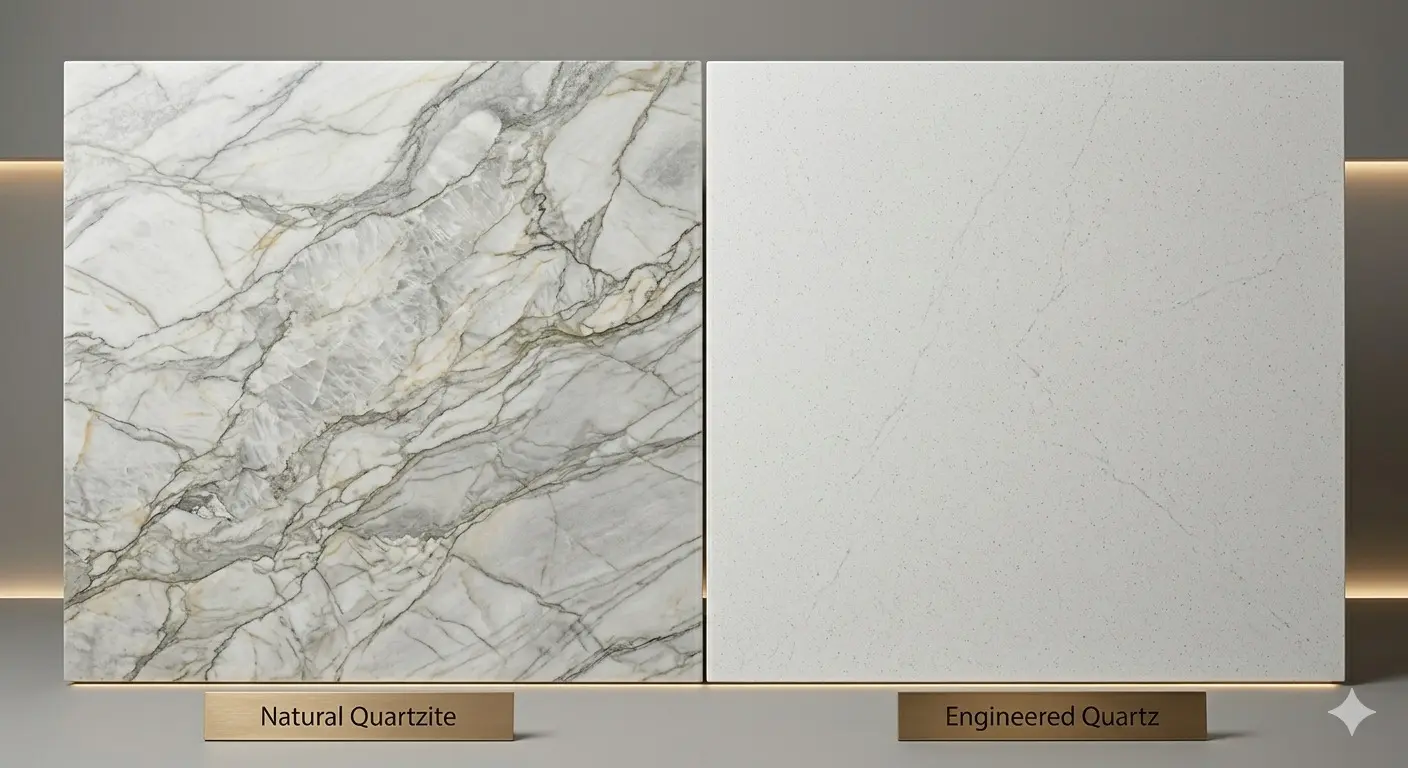
Quartzite offers many of the same visual qualities as marble with significantly greater durability. Varieties with intricate veining and high contrast between background and movement produce particularly striking results. Quartzite is a strong choice for kitchen applications where durability is a priority alongside aesthetics.
Granite has historically been less associated with bookmatching because many granite varieties have a uniform, granular appearance. However, granites with pronounced movement, banding, or color variation can achieve bold mirrored effects. According to Fine Homebuilding, selecting stone in person at the slab yard is especially important for bookmatching because the full pattern only becomes visible at slab scale.
Travertine and onyx are also used in bookmatched applications, particularly in bathrooms and feature wall contexts. Onyx, with its translucent quality and high-contrast banding, produces unusually vivid mirror patterns that read almost like abstract art when lit from behind.
As a general rule, any stone with linear patterns, heavy veining, or strong directional movement has the potential for a successful bookmatch. Low-variation or heavily speckled stones will not produce the same effect.
Bookmatching Styles and Orientations
Not all bookmatched installations look the same. The orientation of the slabs and the number of slabs involved create different visual outcomes.
Standard (vertical) bookmatching places two slabs side by side in a vertical orientation so the veining mirrors along a central vertical axis. This is the most common configuration and works well on wide surfaces like kitchen islands, full-height backsplashes, and fireplace surrounds.
Horizontal bookmatching rotates the orientation so the mirror line runs horizontally. This creates an expansive, grounded effect that suits countertop applications and flooring installations where a wide, continuous surface is the goal.
Quad-matching extends the technique to four slabs, creating a four-way mirror pattern around a central point. Quad-matched installations are typically reserved for large feature walls, grand entry floors, or statement bathroom installations where maximum visual impact is the objective. As This Old House notes, quad-matching requires precise planning and slab selection to achieve a clean result, and it significantly increases the amount of stone involved in the project.
Where Bookmatched Slabs Are Used
The defining characteristic of bookmatched stone is its scale. To make the most of the mirror effect, the application needs enough surface area for the symmetry to register visually. Small surfaces with interrupted patterns dilute the impact.
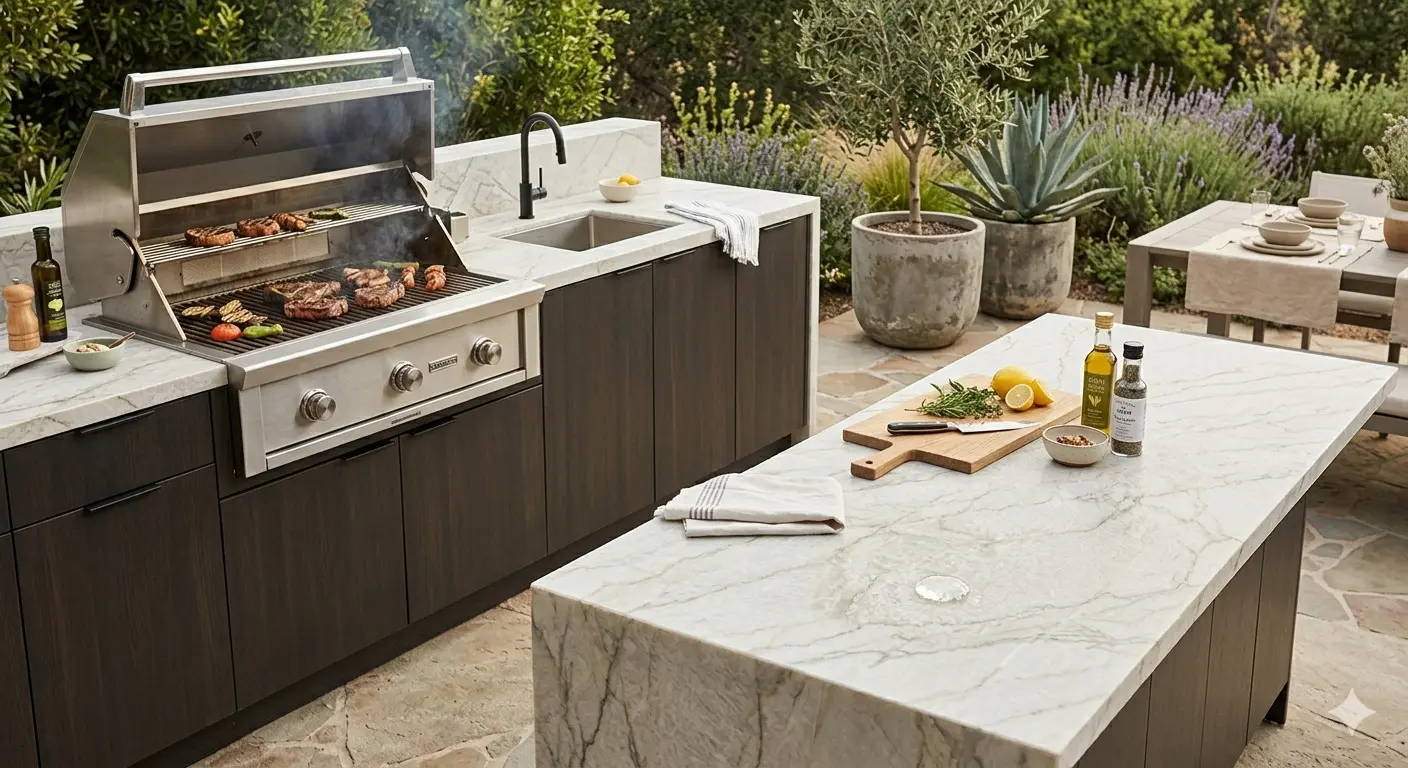
Kitchen islands are one of the most popular applications for bookmatched slabs. A large island surface gives the pattern room to develop, and the central position of most islands in an open floor plan means the stone becomes an immediate focal point. Extending the bookmatch from the countertop down a waterfall edge amplifies the continuity further.
Full-height backsplashes carry the stone from countertop level to the underside of upper cabinets or ceiling, giving the mirrored veining an uninterrupted vertical field. When the backsplash stone is bookmatched to the countertop surface, the result is a seamless visual flow across both horizontal and vertical planes.
Bathroom vanities and shower walls are strong candidates for bookmatching, particularly in primary bathrooms where design intent is high. A bookmatched vanity wall or shower surround transforms a functional room into a spa-caliber space. The enclosed dimensions of most bathrooms also mean a bookmatched panel reads at close range, which intensifies the visual effect.
Fireplace surrounds have long been a showpiece application for bookmatched stone. Floor-to-ceiling installations with bold-veined marble or quartzite create an installation that functions as both a fireplace and a piece of architectural art.
Feature walls and accent walls in living areas, dining rooms, and entryways are increasingly popular applications as homeowners look for ways to bring the material presence of natural stone beyond the kitchen and bath. A bookmatched feature wall in an entryway or behind a bed sets a visual tone for the entire space.
What to Look For When Selecting Bookmatched Slabs
Selecting bookmatched slabs requires seeing the stone in person. Photographs and digital samples cannot convey the full scale of the veining pattern, the intensity of the movement, or the way color reads under your specific lighting conditions. Visiting a showroom where slabs are displayed standing upright allows you to see both slabs in the pair positioned as they would appear installed.
When evaluating a pair, stand back far enough to take in the full width of both slabs simultaneously. The mirror line where the two slabs meet is the most critical visual element. A well-matched pair will feel intentional and symmetrical. Mismatches in veining scale or color tone become more apparent at this viewing distance than they do up close.
Consider the slab's veining direction in relation to the surface orientation. Vertical veining on a countertop application draws the eye across the surface in a different way than horizontal veining, and neither is inherently better. The question is which orientation suits your specific layout and design intent.
We carry an extensive natural stone slab inventory across our showrooms and offer free design consultations to help you evaluate bookmatched pairs before you commit to a selection. As a direct stone importer with showrooms in Reno, Minden, Sacramento, and Fernley, we source stone directly so our team can speak to what is available, what pairs well, and what will perform in your specific application.
Caring for Bookmatched Stone Surfaces
Bookmatched stone requires the same care regimen as any natural stone surface. The maintenance requirements depend primarily on the stone type rather than the bookmatching configuration itself.
Marble and quartzite surfaces benefit from sealing before first use and periodic resealing based on the stone's porosity and the level of use the surface sees. A water bead test, where you apply a few drops of water to the surface to see whether it absorbs or beads up, gives you a practical indicator of whether resealing is needed.
Use pH-neutral, stone-safe cleaners for routine maintenance. Acidic products including vinegar, lemon-based cleaners, and citrus solutions can etch the surface of marble over time. Wipe spills promptly, particularly on marble and more porous stone types. The CDC/NIOSH provides additional guidance on safe handling and working with natural and engineered stone surfaces for anyone involved in stone fabrication or renovation work.
Conclusion
Bookmatched slabs represent one of the clearest expressions of what natural stone can do at its most intentional. The technique takes veining that already exists in the stone and organizes it into a deliberate, symmetrical composition that no engineered surface can replicate. Whether the application is a kitchen island, a shower surround, a fireplace wall, or an entry feature, bookmatched stone commands attention and holds it. For homeowners who want a surface that functions as both a working element of the home and a piece of the design, bookmatching is one of the most compelling directions natural stone offers. Our team is available for free design consultations at our showrooms across Northern Nevada and Northern California, and we carry the slab inventory to help you find a bookmatched pair worth building around.
Frequently Asked Questions
What is a bookmatched slab?
A bookmatched slab is a pair of natural stone slabs cut from the same quarry block and polished on opposite faces so that when placed side by side, their veining patterns mirror each other symmetrically. The name comes from the visual similarity to opening the pages of a book, where both sides reflect the same image.
What stones are best for bookmatching?
Stones with bold, directional veining are best suited for bookmatching. Marble, quartzite, granite with strong movement, travertine, and onyx are the most commonly used materials. Stones with subtle, uniform, or heavily speckled patterns do not produce the same visual impact when mirrored.
Where can bookmatched slabs be used?
Bookmatched slabs are used in kitchen countertops and islands, full-height backsplashes, bathroom vanities, shower walls, fireplace surrounds, accent walls, flooring in large entryways, and any application where a large continuous stone surface is the focal point of the space.
Is bookmatched stone more expensive than standard stone?
Bookmatched stone typically costs more than standard slab applications because it requires numbered, sequentially cut slab pairs, precise handling to keep the pair together through distribution, and careful layout planning to align the veining correctly. The increased cost reflects both the material sourcing requirements and the level of craftsmanship involved.
Do I need to see bookmatched slabs in person before buying?
Yes. Photographs and small sample chips do not accurately represent how a bookmatched pair reads at full scale or under your specific lighting conditions. Evaluating both slabs together, standing upright as they would be installed, is the most reliable way to assess the quality and symmetry of the match before committing to the material.